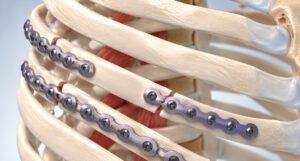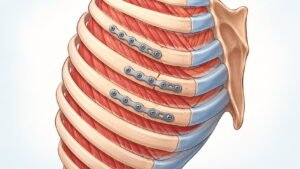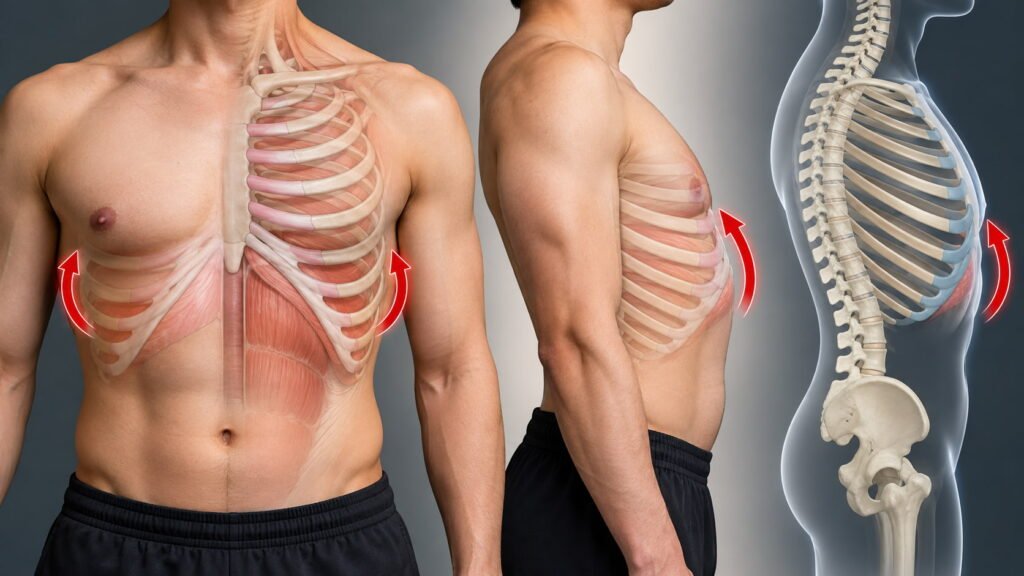
Rib flare is a common postural pattern, but it is often misunderstood. It describes the lower ribs sitting or projecting forward rather than remaining comfortably stacked over the pelvis. This may develop through bad posture, ineffective breathing habits, weak or poorly coordinated core muscles, tight back muscles, or compensation after injury.
In some cases, however, a visible flare may reflect the natural shape of the rib cage or an underlying structural issue.
This complete guide explains how to recognise rib flare, use safe exercises to improve rib control and know when symptoms need professional assessment.
Key Takeaways
- Rib flare occurs when the lower ribs protrude forwards or outwards rather than sitting in line with the pelvis. It is often linked to weak abdominal muscles, tight muscles and ineffective breathing.
- Breathing exercises, core-strength work, and posture changes can improve rib flare over time.
- Pain, injury, deformity, clicking or breathlessness need medical assessment rather than self-managed exercises.
What Is Rib Flare and How Does It Differ from Normal Ribs?
Rib flare describes a lower rib cage that tilts forwards and outwards rather than sitting in line with the pelvis. From the side, the rib cage may protrude beyond the abdomen, creating a visible ledge beneath the chest. In a neutral position, the ribs connect smoothly to the sternum and costal cartilage without this forward projection. The infrasternal angle, where the costal margins meet beneath the sternum, may also appear wider, often above 110°, alongside a pronounced lower-back arch.
Rib flare can affect both sides or be more noticeable on one side, such as a left rib flare associated with trunk rotation or scoliosis. Although some people naturally have a more flared ribcage, persistent flare may affect breathing, body function and muscle balance.
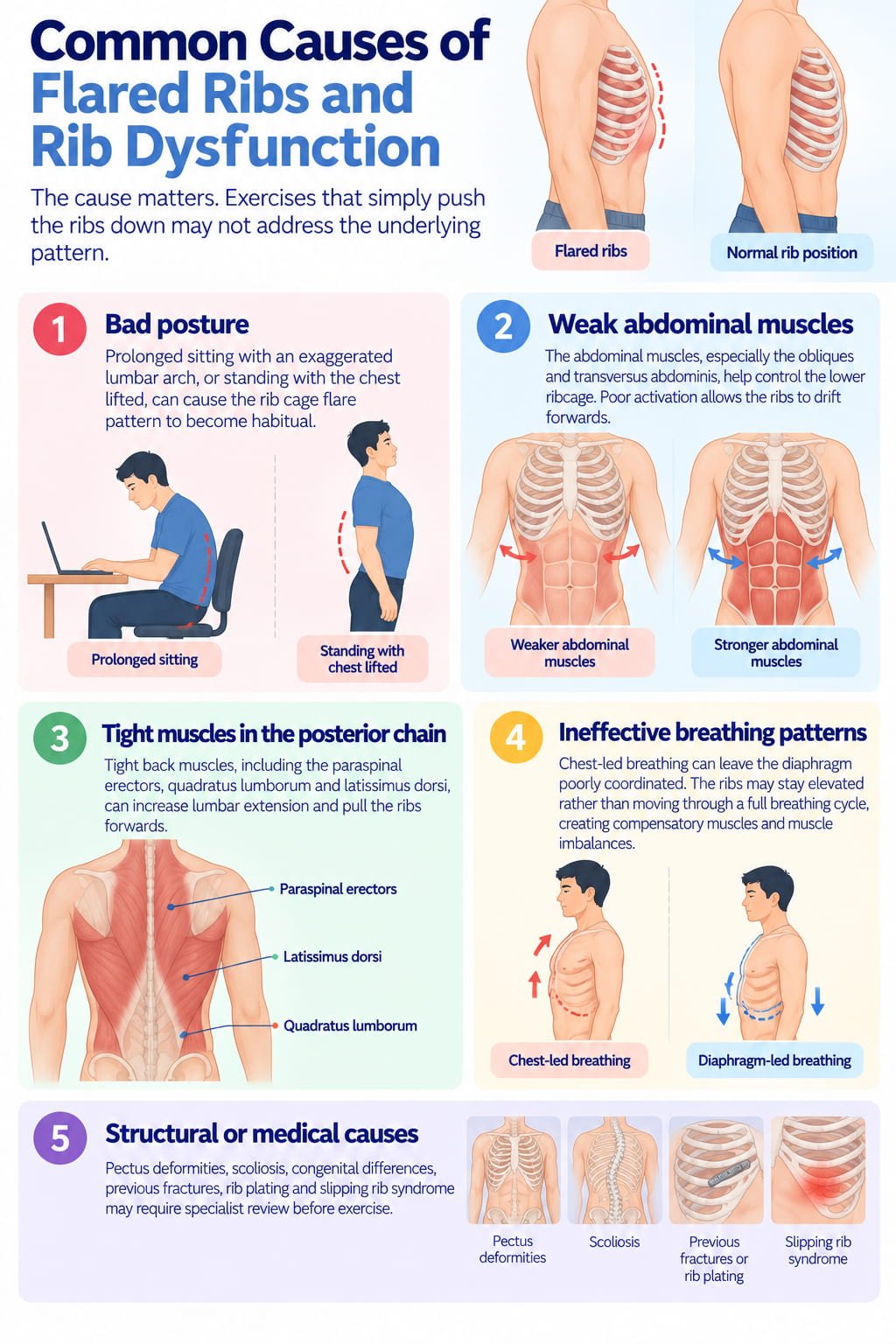
Common Causes of Flared Ribs and Rib Dysfunction
The cause matters. Exercises that simply push the ribs down may not address the underlying pattern:
Bad posture
Prolonged sitting with an exaggerated lumbar arch, or standing with the chest lifted, can cause the rib cage flare pattern to become habitual.
Weak abdominal muscles
The abdominal muscles, especially the obliques and transversus abdominis, help control the lower ribcage. Poor activation allows the ribs to drift forwards.
Tight muscles in the posterior chain
Tight back muscles, including the paraspinal erectors, quadratus lumborum and latissimus dorsi, can increase lumbar extension and pull the ribs forwards.
Ineffective breathing patterns
Chest-led breathing can leave the diaphragm poorly coordinated. The ribs may stay elevated rather than moving through a full breathing cycle, creating compensatory muscles and muscle imbalances.
Structural or medical causes
Pectus deformities, scoliosis, congenital differences, previous fractures, rib plating and slipping rib syndrome may require specialist review before exercise.
How to Tell If You Have Rib Flare: Simple Home Tests
These checks are for awareness, not diagnosis. They should be pain-free.
Standing mirror test
Stand side-on and relaxed. If the ribs stick out beyond the abdomen, especially with a marked lumbar arch, rib flare may be present.
Supine infrasternal angle check
Lie on your back with knees bent and place your thumbs along the lower ribs below the sternum. Estimate whether the angle is narrow, around 90° or wide. Infrasternal angle measurement can be reasonably reliable when performed consistently.
Wall test
Stand with your heels, pelvis and upper back against a wall. Notice whether the lower ribs push forward and whether there is a large gap under the lower back.
Photographic comparison
Take a photo from above while lying on the ground, then compare it after several weeks of rib flare exercises.
Stop if a position causes sharp pain, chest pain or difficulty breathing. Seek advice from a healthcare professional when this happens.
When to See a Rib Injury Specialist Instead of Just Doing Exercises
Postural rib flare differs from dysfunction caused by injury or disease. Exercises cannot correct every structural problem.
- Red-flag symptoms: sudden pain after a fall or tackle, visible chest deformity, breathlessness, or clicking and slipping at the lower ribs or sternum.
- Persistent symptoms: chest wall pain lasting over six weeks, pain that interrupts sleep, or symptoms not improving with physiotherapy.
Imaging such as CT, MRI or ultrasound may be needed for fractures, costal cartilage injury, slipping rib syndrome or chronic post-fracture pain. Some conditions may need procedures such as rib plating, cartilage surgery or intercostal nerve cryoablation alongside rehabilitation.
A Rib Injury Specialist can assess structural or persistent rib problems, particularly after thoracic surgery, trauma or failed treatment.
Breathing Exercises to Fix Rib Flare and Ineffective Breathing
Breathing retraining helps restore rib positioning. Focus on a controlled exhale before progressing to loaded exercises.
- The principle: use a long exhale to allow the ribs to move down and in. Then inhale into the back and sides of the rib cage instead of lifting the chest.
- Crook-lying breathing exercise. Lie on your back with knees bent. Place one hand on the lower rib cage and one on the abdomen. Exhale slowly, then take a deep breath into the sides and back of the ribs.
- Lateral and posterior expansion breathing. In child’s pose, or draped over a small ball or towel, breathe into the sides and back of the ribcage. This can help fix flared ribs by reducing forward expansion.
- Complete 5–10 slow breaths for each set, a few times daily. Avoid neck tension, breath-holding and forcefully pushing the belly out.
A meta-analysis of respiratory training in rib-fracture rehabilitation found improved lung function and fewer pulmonary complications. Although this evidence relates to fractures, it supports structured breathing work for the chest wall. If you have lung disease, significant breathlessness or recent surgery, check with your doctor before intensive breathing drills.
Core Activation: Training the Abdominal Muscles to Control the Lower Ribs
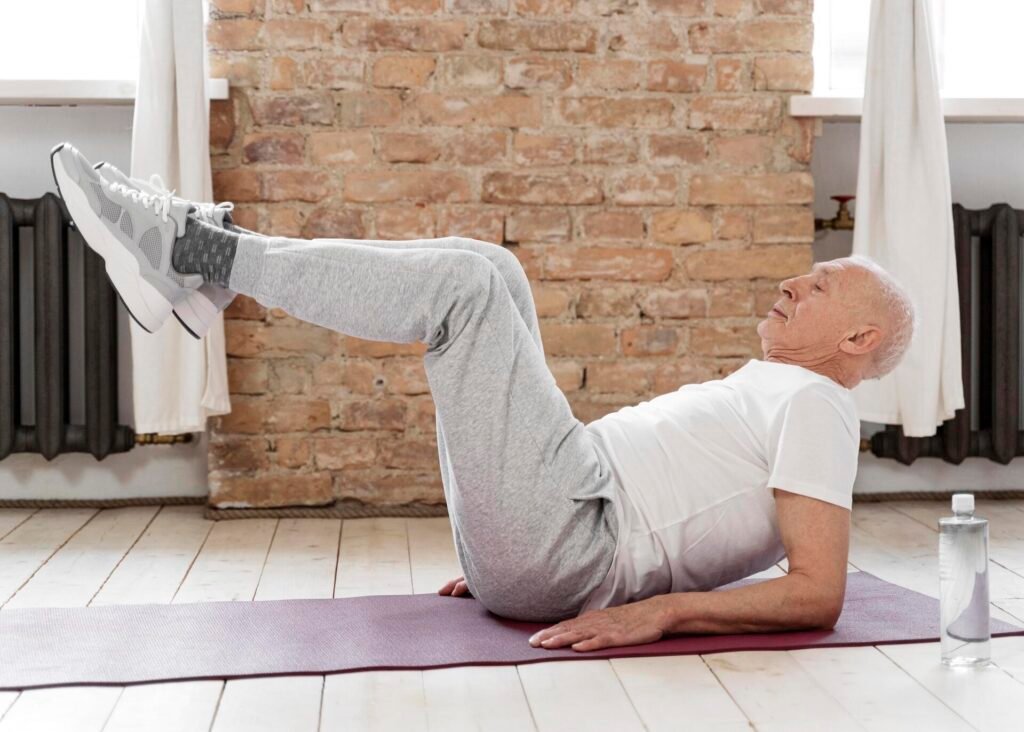
Core muscles help keep the rib cage aligned over the pelvis in a more neutral position, with an emphasis on control rather than force. The transversus abdominis provides deep stabilisation, while the internal and external obliques help draw the lower ribs towards the pelvis. To practise this, lie on your back with your knees bent and exhale through pursed lips. Gently tighten your abdominal muscles as though zipping upwards from the pubic bone towards the sternum, allowing the lower ribs to settle without flattening the spine.
You should feel a light, corset-like tension around your waist rather than a forceful sucking in of the stomach. Keep your shoulders and neck relaxed throughout. If you have an acute fracture or have recently undergone surgery, avoid painful bracing and follow your clinician’s rehabilitation plan.
Foundational Rib Flare Exercises in Supported Positions
These exercises target rib flare patterns in supported positions, reducing load while improving control.
Supine rib retraction drill
Lie on your back with knees bent. Place your hands on the lower ribs and use a gentle exhale with light pressure to guide them towards the body. This simple exercise should never feel forced.
Isometric hip flexion (90°/90° tabletop)
Lie on your back with your hips and knees at 90°. Rest your hands on your knees. Exhale, bring the ribs down and hold for several breaths while maintaining contact with the mat.
Wall-supported standing variation
Face a wall with a slight lean, light pressure through the arms and soft knees. Exhale to find a more optimal position, then breathe quietly without lifting the ribs.
Complete 2–3 sets of 5–8 controlled breaths. Pain-free movement matters more than volume.
Dead Bug Exercise Progressions for Rib Control
The dead bug exercise develops abdominal control while limiting rib flare. Research in 44 healthy women found that the dead bug produced the greatest increase in transversus abdominis thickness among the exercises studied.
- Basic set-up. Lie on your back with hips and knees at 90° and arms towards the ceiling. Exhale and bring the ribs into a neutral position before moving. This is your starting position.
- Arm drop only. Lower one arm overhead, such as the right arm, while keeping the legs still. Exhale as the arm lowers, then inhale as it returns. Repeat with the opposite arm.
- Leg drop only. Slowly lower one leg towards the ground while maintaining rib and spinal control. Focus on the lower portion of the abs as the leg extends.
- Combined arm and leg. Reach the opposite arm and leg away together. If the lower rib cage flares, return to an easier version of the dead bug.
- Progress only with guidance after recent rib fracture, chest surgery or flail-chest repair.
Progressing to Functional and Upright Exercises
Once you can control your rib cage while lying on the ground, the next step is to maintain that control during daily activities and sport. Start with quadruped rocking on your hands and knees, keeping your hips below your shoulders and rocking forwards and backwards without letting the rib cage drop.
As your control improves, progress to lifting the opposite arm or leg. Half-kneeling and split-squat variations further challenge pelvic stability, so keep your ribs down, breathe into your back and maintain level hips as you move through internal and external rotation.
For overhead movements, practise wall slides, landmine presses or light overhead exercises while keeping the rib cage controlled and avoiding excessive back extension to lift the ribs. Stretching tight hip flexors and improving thoracic mobility with a foam roller may also help reduce compensatory movements.
Throughout these exercises, prioritise proper form over heavier loads. As mentioned in previous sections, if you experience sharp rib or chest pain, stop the exercise, return to an easier variation if appropriate and consult a physical therapist.
Unilateral (One-Sided) Rib Flare and Pelvic/Rib Asymmetry
One-sided rib flare can result from asymmetrical breathing, a previous injury, pelvic tilt or scoliosis. A more prominent left or right lower rib may reflect trunk rotation, stiffness or an old sports injury, while scoliosis can also cause one side of the rib cage to appear more pronounced.
Targeted side-lying breathing may help improve awareness and control. For example, if the left side is more prominent, lie on your left side with a small pillow for support and focus on breathing into the lower ribs against the surface. Placing a ball against the more prominent area may also provide feedback during breathing exercises.
If you have a visible spinal curvature, long-standing asymmetry or persistent discomfort, seek a biomechanical assessment and discuss whether imaging is appropriate.
Integrating Rib Flare Rehab into Daily Life
Progress comes from applying these techniques consistently throughout your daily routine, not just during exercise sessions. When sitting at a desk, keep your feet flat, shoulders relaxed, and rib cage aligned over your pelvis. Breathe into the back and sides of your rib cage rather than holding your chest high.
Before lifting objects or climbing stairs, exhale gently and engage your abdominal muscles lightly to help control rib flare under load. Your sleeping position can also affect comfort, and lying on your side with a pillow between your knees and support under your upper arm may be more comfortable than sleeping face down.
Consistency matters more than intensity. You may notice improvements within 4–6 weeks, while more established movement patterns can take 3–6 months to change. Track improvements in comfort, breathing and movement rather than focusing on appearance alone.
How a Rib Injury Specialist Can Help
Mr Marco Scarci is a London-based rib injury specialist who assesses chest wall conditions that extend beyond posture-related rib flare. Consultations are available for rib fractures, flail chest, slipping rib syndrome, costal cartilage injuries, chronic chest wall pain and sternal fractures.
Where appropriate, a consultation and assessment may include CT, MRI or ultrasound, with treatment options ranging from rehabilitation guidance to rib fixation, chest wall reconstruction or intercostal nerve cryoablation. Reviews also consider the chest wall and internal organs when symptoms or an injury history indicate this is necessary. Seek assessment if rib symptoms affect sport, work, sleep or breathing.
FAQ
Can flared ribs be completely corrected with exercises alone?
Many posture-related cases improve with breathing exercises, core strength training and better movement habits. Congenital chest shape, scoliosis and old bony deformity may not fully change. The practical goal is improved comfort, breathing and an optimal position for your anatomy.
How long does it usually take to see improvement in rib flare?
Some people improve within 4–6 weeks, while established patterns may take 3–6 months. Consistent technique is more important than high repetitions. Recovery may take longer after trauma or surgery.
Is it safe to do these exercises if I’ve had a rib fracture or chest surgery?
Gentle breathing may begin early in recovery, but loaded exercises such as the dead bug, planks and overhead work should wait until healing is confirmed. Obtain personalised advice from your treating surgeon or physical therapist before following a generic programme.
Can rib flare cause long-term damage if I ignore it?
Postural flare is usually a movement-efficiency or appearance concern. Rib dysfunction after injury can lead to persistent pain, limited breathing and protective movement patterns. Seek assessment for recurring slipping, breathlessness or ongoing chest discomfort.
Do I need special equipment to work on flared ribs at home?
Most people need only a mat, wall, small ball, pillow or foam roller. Resistance bands, light weights and other equipment can be added later as control improves.

Mr Marco Scarci
Consultant thoracic surgeon at Imperial College Healthcare NHS Trust, specialising in rib and chest wall conditions. Mr Scarci has performed over 5,000 minimally invasive thoracic procedures and treats slipping rib syndrome, rib fractures, and chest wall pain at five London hospitals.